💡
Terminology Note: In this studio, Synthetic Intelligence (SI) refers to non-biological cognitive architectures (Global Workspace Theory, Active Inference, Dual-Process) engineered from first principles. It is NOT to be confused with Superintelligence (which is covered in the ASI Catalogue).
Global Workspace Theory (GWT)
System 1 & System 2
Active Inference Loop
Synthetic Cognitive Architecture Studio
Simulate a multi-layered synthetic cognitive agent. Test how competitive sensory attention routes percepts into a unified Global Workspace bottleneck, dynamically escalating low-confidence stimuli from reflex responses to formal deliberative reasoning.
Attention Focus
Sensory Buffer #1
Cognitive Mode
System 1 (Reflex)
Sensory Free Energy
0.24 nats
Inference Loop
Active (100 Hz)
Cognitive Parameters
Fast Heuristic (0.2)
0.65
Formal Proof (0.9)
Global Workspace Blackboard State Synchronized
[T=0.00s] Perceptual Ingestion: Continuous vector stream received from sensor manifold.
[T=0.02s] Attention Competition: Winner-take-all broadcast to Global Workspace memory buffer.
[T=0.05s] Routing Evaluation: Neural reflex confidence (0.88) satisfies threshold. System 1 triggered without CPU deliberation.
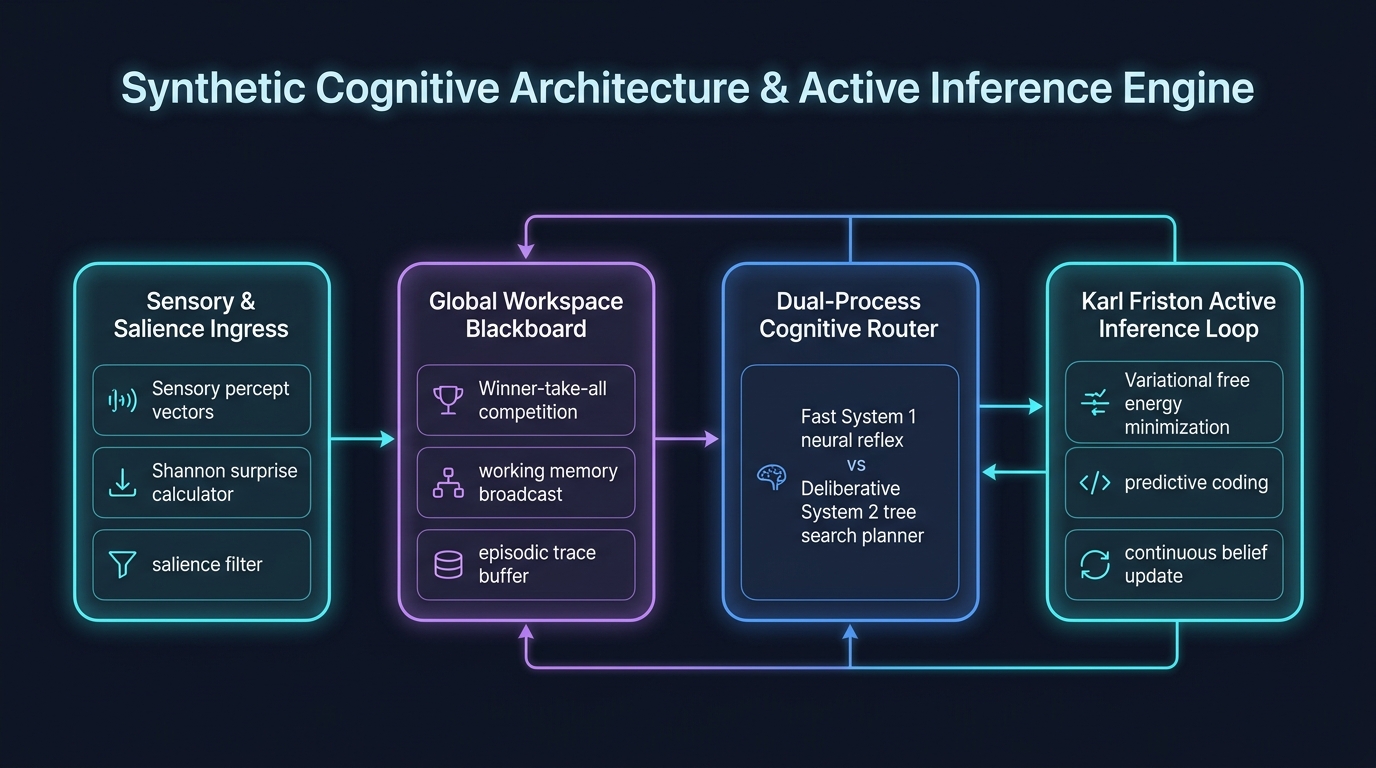
🏗️ System Architecture & Execution Topology
End-to-end mathematical dataflow, modular arbitration, and verification guardrails powering the Synthetic Cognitive Architecture Studio runtime.
Cognitive Architecture
Global Workspace Theory (GWT), Stanislas Dehaene Blackboard
Shared broadcast bus coordinating subconscious sensory specialists
Inference Principle
Karl Friston Active Inference & Variational Free Energy
Minimizes surprisal F = KL(Q||P) - E[log P(o|s)] via belief updates
Dual-Process Router
System 1 Neural Reflex vs System 2 Deliberative MCTS
Sub-5ms reflexive responses with fallback to formal proof search
Compute & Substrate
Python 3.11+, NumPy, SciPy vector manifolds
High-throughput continuous sensory tensor transformations